
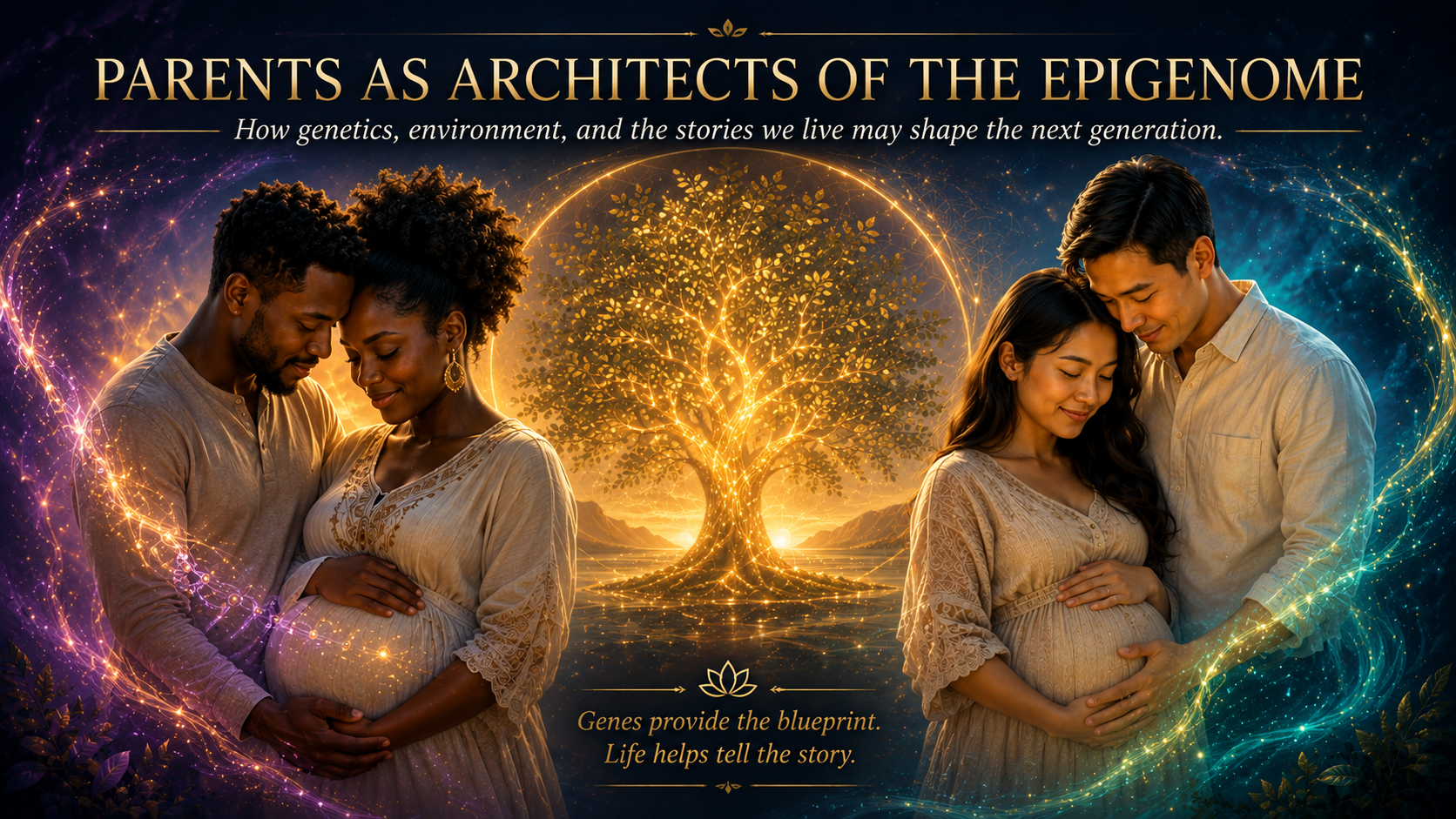
Parents as Architects of the Epigenome
It All Begins Here
How genetics, environment, and the stories we live may shape the next generation.
"Genes provide the blueprint. Life helps tell the story."
Modern genetics has rewritten one of our oldest beliefs.
For generations, we believed our DNA was destiny—that the genes we inherited at conception largely determined who we would become.
Today, science tells a far more hopeful story.
While our DNA sequence remains largely unchanged throughout life, researchers have discovered that genes are constantly responding to the environments in which they exist. Nutrition, movement, sleep, relationships, stress, environmental exposures, and many other factors all influence how our biology functions.
This field is known as epigenetics.
Rather than changing our DNA, epigenetics helps explain how the body reads and regulates it.
For parents, this realization is profound.
Long before a child takes their first breath, they are already developing within an intricate biological environment shaped by countless signals from the world around them.
And perhaps the most fascinating question is not simply how biology responds—
but how much it responds.
What Is Epigenetics?
Imagine your DNA as the blueprint for building a home.
The blueprint contains every instruction needed to build the structure, but it doesn't decide how the home will be furnished, maintained, or adapted over time.
Epigenetics is one of the systems that helps regulate how those instructions are used.
Scientists have identified biological mechanisms—including DNA methylation and histone modification—that help determine when certain genes become more or less active.
This is why every cell in your body contains essentially the same DNA, yet a brain cell behaves very differently from a heart cell or a skin cell.
Genes matter.
Environment matters too.
Health is shaped by the continuous conversation between them.
Three Remarkable Windows of Development
Before Pregnancy
Both parents contribute more than DNA.
Research suggests that nutrition, metabolic health, smoking, alcohol, environmental exposures, and overall well-being before conception may influence the earliest stages of development.
While scientists continue to explore these relationships, one message is already clear:
Caring for your own health is also an investment in future generations.
During Pregnancy
Pregnancy is one of the most extraordinary periods of human development.
A growing baby receives nutrients, oxygen, hormones, immune signals, and countless biochemical messages through the placenta.
Maternal nutrition, sleep, emotional well-being, and chronic stress all influence this biological environment.
Perfection isn't the goal.
Support is.
A pregnancy surrounded by nourishment, connection, and compassionate care creates conditions that help both mother and baby thrive.
Early Childhood
The first years of life are a remarkable period of brain development.
Children learn long before they understand language.
The warmth of a hug.
The comfort of a familiar voice.
The reassurance of a parent after a frightening moment.
These everyday experiences help shape developing neural pathways and support emotional resilience for years to come.
Beyond the Evidence
Science has shown us that our biology is deeply responsive to the environment.
Beyond this growing body of evidence, many researchers, physicians, psychologists, and philosophers have begun asking even bigger questions.
Researchers such as Michael Meaney, Moshe Szyf, Randy Jirtle, Bruce McEwen, Richard Davidson, and Stephen Porges have each helped expand our understanding of how early development, stress, relationships, meditation, and the nervous system influence human health.
Other thinkers—including developmental biologist Dr. Bruce Lipton—have invited an even broader conversation: Could our perceptions, beliefs, and conscious experience influence biology in ways we do not yet fully understand?
Some of these ideas remain subjects of active investigation and scientific debate.
At Aether Genomics, we don't present unanswered questions as settled facts.
Instead, we believe curiosity belongs in healthcare.
Many of history's greatest discoveries began with someone asking a question that couldn't yet be answered.
The Aether Perspective
We believe human beings are more than a collection of genes.
We are shaped by biology, relationships, environment, lived experience, and perhaps aspects of human consciousness that science is only beginning to explore.
Our commitment is to remain firmly grounded in evidence while staying open to discovery.
Science has always evolved.
Curiosity is one of the reasons it does.
A Final Thought
Perhaps the greatest gift epigenetics offers isn't the promise that we can control every aspect of our biology.
It's the reminder that we are not passive observers of it.
Every nourishing meal.
Every walk outside.
Every repaired conversation.
Every moment of love, safety, and connection becomes part of the environment in which life unfolds.
Genes provide the blueprint.
The lives we live help tell the story.
Learn More
Whether you're planning a pregnancy, navigating a genetic diagnosis, exploring your family history, or simply curious about the emerging science of epigenetics, Aether Genomics is here to help you understand your biology through a compassionate, evidence-based lens—while remaining open to the deeper questions that make us human.
Selected References
National Human Genome Research Institute (NHGRI)
National Institute of Environmental Health Sciences (NIEHS)
Centers for Disease Control and Prevention (CDC)
American College of Obstetricians and Gynecologists (ACOG)
World Health Organization (WHO)
Meaney MJ & Szyf M.
Jirtle RL.
McEwen BS.
Davidson RJ.
Porges SW.
Disclaimer
Educational Purposes Only: This article is intended for educational purposes only and does not constitute medical, genetic, psychological, or mental health advice. Always consult your physician, genetic counselor, or another qualified healthcare professional regarding your individual circumstances.
Scientific Perspective: This article distinguishes between established scientific evidence, emerging research, and exploratory perspectives. Sections discussing broader philosophical questions are intended to encourage thoughtful inquiry and should not be interpreted as established medical fact.
No Provider–Patient Relationship: Reading this article or contacting Aether Genomics does not establish a healthcare provider–patient relationship.